






Automatic Watches for Men: How the Self-Winding Mechanism Works

Most men who buy their first automatic watch are drawn by how it looks — the skeleton dial, the moving parts behind the glass, the weight on the wrist. What they rarely know going in is how any of it actually works.
That gap matters. Once you understand the self-winding mechanism, you stop looking at an automatic watch the way you look at any other watch. It becomes something else entirely. This guide explains the mechanics plainly, covers what separates a well-built automatic from one that is not, and helps you choose correctly in India without overpaying for a name you do not need.
What is an automatic watch?
An automatic watch is a mechanical watch that winds itself. There is no battery. No charging. The energy that powers the timekeeping comes entirely from the motion of the wearer's wrist.
The mechanism responsible is called an automatic movement, or self-winding movement. Inside the case, a weighted rotor spins freely on a pivot. As your wrist moves through the day, the rotor swings with it, turning a series of gears that wind a coiled metal spring called the mainspring. That spring, as it uncoils under tension, drives the gear train that moves the watch hands.
Wear the watch for a full day and it stays wound. Leave it sitting on a shelf for 48 hours and it will stop — because the mainspring runs out of tension. This is normal behaviour, not a defect.
How the self-winding mechanism works: step by step
Understanding this takes about two minutes and makes every automatic watch you ever own more interesting to wear. Five components. One chain of physics.
How energy moves through an automatic movement:
| Rotor | Spins with wrist motion in both directions |
| Mainspring | Stores energy as coiled metal tension |
| Gear Train | Transmits energy from barrel to escapement |
| Escapement | Releases gear train in equal, controlled steps |
| Balance Wheel | Oscillates at fixed frequency — sets the beat rate |
The rotor is a semicircular weighted disc, usually visible from the case back. It rotates freely in both directions. Most modern movements use a bidirectional winding system — the rotor winds the mainspring whether it spins clockwise or counterclockwise.
The mainspring is a long, thin strip of metal, coiled tightly inside a cylindrical housing called the barrel. When the rotor winds the spring tighter, it stores potential energy. When the spring releases, that energy transfers through the gear train.
The gear train transmits the energy from the mainspring outward through a series of precision gears, each turning at a calculated ratio. The final gear connects to the escapement.
The escapement consists of a pallet fork and an escape wheel that work together to release the gear train in controlled, equal increments. Each tick is one release. Without the escapement, the mainspring would release all its energy in a fraction of a second and the hands would spin uselessly.
The balance wheel oscillates back and forth at a fixed frequency — typically 6, 7, or 8 beats per second in modern movements — keeping the gear train releasing at a consistent rate. It is what gives an automatic watch its rhythm.
All of this happens in a space roughly the size of a ten-rupee coin.
Movement components at a glance
| Component | Role in the movement | What fails if it breaks |
| Rotor | Spins with wrist motion, winds the mainspring | Watch stops winding automatically |
| Mainspring | Stores energy as coiled tension |
Watch loses power reserve |
| Barrel | Houses the mainspring, releases energy gradually | Uncontrolled energy release |
| Gear Train | Transmits energy from barrel to escapement | Hands stop moving |
| Escapement | Releases gear train in equal steps | Watch runs fast or stops entirely |
| Balance Wheel | Oscillates at fixed frequency, sets beat rate | Watch loses accuracy |
| Hands | Display the output of the gear train |
Time becomes unreadable |
This table also explains why regular service matters. Each component needs clean lubrication to function at specification. A dried-out mainspring or sticky escapement affects the whole chain — one component's friction becomes every component's problem.
Automatic vs quartz: an honest comparison
This comparison comes up in every automatic watch conversation, and most content handles it badly — either dismissing quartz or overselling automatics.
A quartz watch uses a battery to vibrate a quartz crystal at 32,768 times per second. A microchip counts those vibrations and advances the motor that moves the hands. The result: accuracy within 15 seconds per month, near-zero maintenance, and a price point that makes good watchmaking widely accessible.
An automatic movement is measurably less accurate. The best regulated movements hold within 5 to 10 seconds per day. A typical entry-level automatic runs at plus or minus 20 to 30 seconds daily. Over a month, that is a real, visible drift. For timekeeping precision, quartz wins without argument.
What automatic offers in return is the craft of the movement itself — hundreds of individually machined components, toleranced to fractions of a millimetre, operating for decades without a power source beyond gravity and wrist motion. The accuracy trade-off is what you accept in exchange for that experience.
One detail that surprises many first-time buyers: automatic watches are not maintenance-free. The lubricants inside the movement dry out over time. A proper service — where the movement is disassembled, cleaned, re-oiled, and tested — is needed every three to five years to maintain accuracy. This is the ongoing cost that quartz avoids entirely.
| Factor | Automatic | Quartz |
| Power source | Wrist motion — no battery needed | Battery, replaceable every 2–3 years |
| Accuracy | ±10 to 30 seconds per day | ±15 seconds per month |
| Maintenance | Full service every 3–5 years | Battery change only |
| Lifespan | Decades with proper servicing |
10–15 years with care |
| Price for equivalent quality | Higher |
Lower |
| Primary appeal | Mechanical craft, visible movement | Precision and low maintenance |
The right choice depends entirely on what you are buying the watch for. Both are valid. This is not a competition — it is context.
Power reserve: what it means and why it matters
Every automatic watch has a power reserve rating — the length of time the watch will continue running from a fully wound mainspring without additional wrist movement.
Most modern automatic watches carry a power reserve of 38 to 48 hours. Some higher-end movements extend to 72 hours or beyond. A 40-hour reserve means you can take the watch off Friday evening, leave it on your dresser, and it will still be running when you pick it up Sunday morning.
If the watch stops, nothing is wrong. Wind it manually using the crown — unscrew the crown first if it is a screw-down type, then turn it clockwise for 20 to 30 full rotations. Do not wind past the point of resistance.
What to look for when buying an automatic watch for men
Movement grade and origin
The movement inside the case determines accuracy, durability, and how long the watch will last between services. Japanese movements from manufacturers like Miyota (owned by Citizen) are the workhorses of the mid-range market — reliable, well-supported, accurate within 10 to 20 seconds per day. Swiss movements from ETA or Sellita are what most European brands use in their entry-level pieces.
In India, a genuine automatic watch for men under ₹5,000 with a named, traceable movement is rare enough to take seriously when you find one.
Case material
Stainless steel — specifically 316L grade — is what you want. It resists corrosion, holds its finish, and does not react with skin. Zinc alloy cases are lighter and cheaper but dent more easily and can cause skin irritation over time. If a listing says "metal case" without specifying the steel grade, ask before buying.
Crystal type
The glass over the dial should be mineral crystal at minimum. Acrylic scratches too easily for daily wear. Sapphire crystal, found on higher-end watches, is nearly scratch-proof — rarely available at this price tier in India, but worth knowing about if you find it.
Skeleton or closed dial
An open-heart or skeleton dial reveals the movement through the front crystal. This is the most visually distinctive feature of an automatic watch, and the primary reason most buyers choose one over a quartz alternative. If seeing the mechanism work in real time matters to you, look specifically for skeleton automatic watches for men.
Water resistance rating
For everyday wear, 3 ATM is adequate — it handles rain and hand washing without issue. 3 ATM does not qualify a watch for swimming. For regular water contact beyond splashing, look for 5 ATM or above.
Warranty and service access
An automatic watch from a brand that offers no service support, no spare parts, and no clear warranty terms is an expensive ornament. The ability to service the watch — and return to the brand when it needs attention — is part of the cost calculation for any automatic purchase.

Why automatic watches are growing in India
Five years ago, the idea of spending ₹4,000 on an automatic watch made in India was not a mainstream conversation. It is now, and the reasons are straightforward.
The D2C model changed what buyers accept. Brands that sell directly online publish their specifications — mineral crystal or acrylic, Miyota movement or unnamed, 316L steel or zinc alloy. This transparency did not exist in the general market a decade ago. It gave buyers the vocabulary to compare, and that vocabulary changed what they would tolerate.
A generational shift in expectations matters too. Indian consumers who grew up watching domestic manufacturers produce devices matching global specifications at a fraction of the import price carried that expectation into every category. If a phone can be world-class and Indian-made, why not a watch?
India's climate is also a practical factor. Heat and humidity are genuinely hard on watches. An automatic with a properly sealed case and 3 ATM water resistance handles the monsoon season and daily perspiration better than a fashion watch with acrylic crystal and a zinc alloy case. Buyers who have owned both tend to notice the difference.
The result: automatic watches for men under ₹5,000 now have a real, growing market in India where none meaningfully existed before.
Sylvi automatic watches for men
Sylvi has been building watches in India since 2015, manufactured and quality-controlled in Surat. Every design in the automatic range goes through the Prototype Program — tested by real customers before commercial launch. Each watch carries a 1-year warranty: 6 months manufacturing coverage plus 6 months extended warranty after product registration.
In India, the practical entry point for a named-movement automatic under ₹5,000 is limited to a small number of domestic brands. Sylvi's automatic range covers three price points, all with transparent case backs and mineral crystal glass.
Pulse Skeleton — From ₹3,999
Entry point. Open-heart dial, transparent case back, rotor and gear train visible from both sides. Designed through the Prototype Program. Best for first-time automatic buyers.
Core X — From ₹4,499
Modern format. Geometric skeleton cutouts, contemporary case proportions. For buyers who want the mechanical view without a traditional round case.
Gravitas — From ₹5,499
Statement piece. Octagon case, steel bracelet, skeleton dial. The top of the automatic range.
Browse the full Sylvi automatic watches collection to compare current models, or explore the complete watches for men range including quartz and chronograph options.
How to care for an automatic watch
Automatic watches need more attention than quartz — but not much more. Five straightforward rules cover most of it.
Wear it regularly. A watch that sits unworn loses power and can develop lubricant pooling in the movement over time. If you are not wearing it daily, a watch winder keeps the rotor moving and the mainspring under tension.
Keep it away from strong magnets. Modern movements use alloys that are reasonably resistant to magnetism, but strong magnets — laptop speakers, bag clasps, security gates — can still affect the balance wheel and cause the watch to run fast.
Avoid perfume near the watch. The alcohol in perfume damages leather straps and can work its way into case gaskets, degrading water resistance over time. Spray before putting the watch on, not after.
Service it every three to five years. This is not optional if you want the watch to maintain accuracy and last for decades. A service involves disassembling the movement, cleaning each component, replacing worn parts, re-lubricating, and testing accuracy before reassembly.
Store it properly. A watch box or case keeps the watch dust-free and protects the crystal and case from incidental scratches when not worn.
Who should buy an automatic watch?
Automatic watches for men are not for everyone — and that is not a criticism. A ₹2,000 quartz watch with a Japanese movement keeps better time and needs no service for five years. If accurate timekeeping is the primary need, quartz is the rational choice.
Automatic makes sense when what you are buying is the experience of ownership — the weight on the wrist, the slight sweep of the seconds hand, looking through the crystal at something that has no battery. Knowing that what is keeping time on your wrist is pure physics operating at a very small scale. These things do not appear in a specification sheet.
The Sylvi Pulse Skeleton is the lowest-friction entry point into that experience in India. The Gravitas is where it goes when the watch should announce itself a little more. Both are automatic. Both went through the Prototype Program before launch.

FAQ
How does an automatic watch wind itself?
A weighted rotor inside the case spins with wrist movement. The rotor's rotation winds a coiled mainspring through a series of gears. The mainspring's tension powers the gear train that drives the watch hands. No battery is involved at any stage of this process.
How accurate is a men's automatic wrist watch?
Most automatic movements run within 10 to 30 seconds per day, depending on the movement grade, how well it has been regulated, and how recently it was serviced. This compares to less than 1 second per day for quartz. The accuracy gap is real and accepted by buyers who value the mechanical craft over precision timekeeping.
How long does a fully wound automatic watch run?
Most modern automatic watches carry a power reserve of 38 to 48 hours. High-end movements can extend to 72 hours or beyond. If the watch stops, wind it manually using the crown — 20 to 30 turns clockwise — and reset the time. Stopping is normal, not a fault.
Do I need to wind an automatic watch manually?
Only when it has stopped. If worn daily for more than 8 hours, most automatic movements stay sufficiently wound through wrist movement alone. If the watch has been sitting unused, 20 to 30 turns of the crown tops up the mainspring before wearing.
Are automatic watches for men worth buying under ₹5,000?
Yes — if the brand specifies the movement origin and offers service support. Brands that list only "automatic movement" without naming the manufacturer are worth approaching with caution. The named movement and service access are what make the price worth paying over a longer period.
What is a skeleton automatic watch?
A skeleton watch has a partially or fully open dial that lets you see the movement working beneath — the rotor spinning, the escapement ticking, the gear train turning. Some also have a transparent case back so the movement is visible from both sides. Skeleton dials are most common in automatic watches because the visible movement is the reason most people choose one.
How often does an automatic watch need servicing?
Every three to five years. The movement is disassembled, cleaned, re-lubricated, and tested for accuracy. Skipping service does not break the watch immediately, but it shortens movement life and reduces accuracy progressively over time.
What is the best automatic watch for men in India under ₹5,000?
The Sylvi Pulse Skeleton (open-heart dial, visible movement, from ₹3,999) and the Sylvi Gravitas (octagon case, steel bracelet, skeleton dial) are the most specification-transparent options currently available in this range in India — both with named automatic movements, mineral crystal glass, transparent case backs, and 1-year warranty coverage.
Recommended Topics
Latest Watches
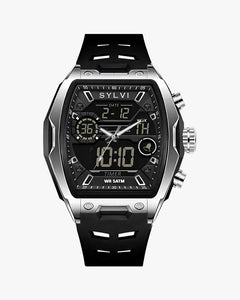
Vanguard Black Silver Silicone
Rs. 1,689.00
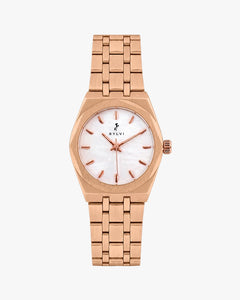
Sia White Rosegold Steel
Rs. 2,329.00
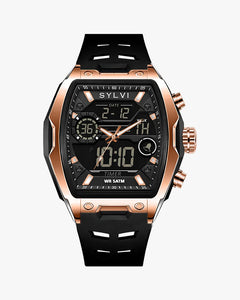
Vanguard Black Rosegold Silicone
Rs. 1,689.00
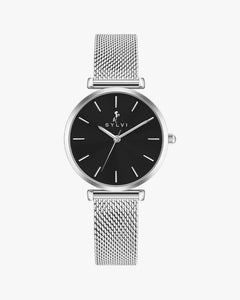
Serene Black Silver Mesh
Rs. 1,699.00

